Skip to content

Are Movie Studios now Restricting when Films can be Reserved?

It has been well documented in the US that one thing movie studios have been demanding in new rental contracts is a time delay between films being released for sale and being made available for renting, based on the frankly bizarre theory that if they stop us being able to rent a film for a few months we will all go and buy a copy instead, thus making them more profit.

It was always my suspicion that such a demand was behind the long impasse that prevented Universal films being available on LOVEFiLM for the last couple of years, although I have no actual evidence to support this.

That impasse was recently resolved, and at much the same time some films started appearing on LOVEFiLM with a statement at the top that reads:

The studio have licensed us to make this title available to rent on the release date below.

When that message appears the rental release date is normally shown as roughly two months after the sale release date – in other words just the sort of delay the studios have been demanding.

That doesn’t bother me too much though, because you can normally reserve a film as soon as it is listed and it will be sent to you once it is released for rental, but it has been noticeable that at least some films displaying that message cannot be reserved.

I was interested therefore when I noticed the @LOVEFiLM twitter account replying to a query about why such a film couldn’t be reserved as follows:

so I replied, asking why the fact that it wasn’t released yet should affect the ability to reserve it:

in return I got this rather surprising response:

So it seems that the studios now want to control not only when we can rent a film, but when we should be allowed to add it to our queue of things we would like to see… Presumably they they think that the more annoying they can make the process of renting a film, the more likely we are to buy it instead.

I guess what we need now is an external site that runs a pre-reservation list and tracks what we would like to be able to reserve but can’t, so that it can notify us when they become available for reservation in the normal way…

LOVEFiLM and SMS Spam

One thing that consistently annoys me is when seemingly reputable companies decide for some reason that the rules on unsolicited marketing communications, that is to say, in the United Kingdom, the snappily titled “Privacy and Electronic Communications (EC Directive) Regulations 2003“, don’t apply to them for some reason.

The latest organisation to suddenly conclude it has the right to send me such unwanted communications is LOVEFiLM which has recently decided it should send me regular SMS messages full of some banal nonsense.

The first such message I received was two weeks ago, on 18th December 2011, and when I then checked my account settings on LOVEFiLM I was surprised to find that all the various “LOVEFiLM Marketing” preferences where unchecked apart from one labelled “by SMS” which I am quite sure I would never have checked, and certainly not while I was refusing much less annoying things like email marketing.

I immediately unchecked the box and then expressed my annoyance on twitter:

Needless to say my tweet was not one that the @LOVEFiLM account chose to respond to…

I assumed however that, having unchecked the box allowing SMS marketing, that would an end to it. It appears that I couldn’t have been more wrong however as today, two weeks later, another spam SMS was received from them. So twitter has one again been deployed:

In addition to which I have contacted them directly via their web site to let them know what I think:

Two weeks ago, on Sunday 18th December, I was somewhat surprised to received a marketing text message from you. I was surprised because I had never knowingly agreed to receive such messages and I would normally refuse any such invitation as a matter of routine.

I was even more surprised when I checked my account details on your website and found that all the marketing permission boxes were unchecked except the SMS one. I don’t believe I would ever have chosen those settings, so I wonder if you added that option and defaulted it to on without requesting my permission?

In any case I unchecked that box on Sunday 18th December.

Perhaps you can therefore explain why, two weeks later, I have just received another unwanted spam SMS from you in defiance of my clearly stated preferences, and hence illegally, being in breach of the Privacy and Electronic Communications (EC Directive) Regulations 2003.

PLEASE CEASE AND DESIST WITH THIS BEHAVIOUR IMMEDIATELY.

For the avoidance of all doubt please take this message as notice pursuant to regulation 22 of the Privacy and Electronic Communications (EC Directive) Regulations 2003 that you are not to send me unsolicited SMS messages again.

Any repeat will be reported to the Information Commissioner’s office for possible enforcement action with no further notice to yourselves.

Now I will sit back and see if I have managed to get their attention this time and if they are willing to learn that this sort of behaviour is completely unacceptable.

Yes, I Would Like a Refund

So I recently cancelled one of my credit cards – it was an AMEX card with an annual fee that I had only ever intended to hold for one year to get the signup bonuses, and once the fee for the second year came due I cancelled it.

Today I got the final statement which, because of the refund of the fee for the second year, showed a credit balance. Rather than enclosing a cheque for the balance though, or indicating that they had repaid it to the account that I had been using to pay the card bills, the statement had this curious message:

Your account is cancelled and has a credit balance. Please call us if you would like a refund.

What I want to know is, how many people exactly don’t want a refund, and would instead prefer to hand their credit balance over to American Express?!?

Of course their secure messaging system insists on me selecting a card before I can send a message, and won’t let me select a cancelled card, so sending them a message to ask for my refund turned into a bit of a palaver as well…

Important Information

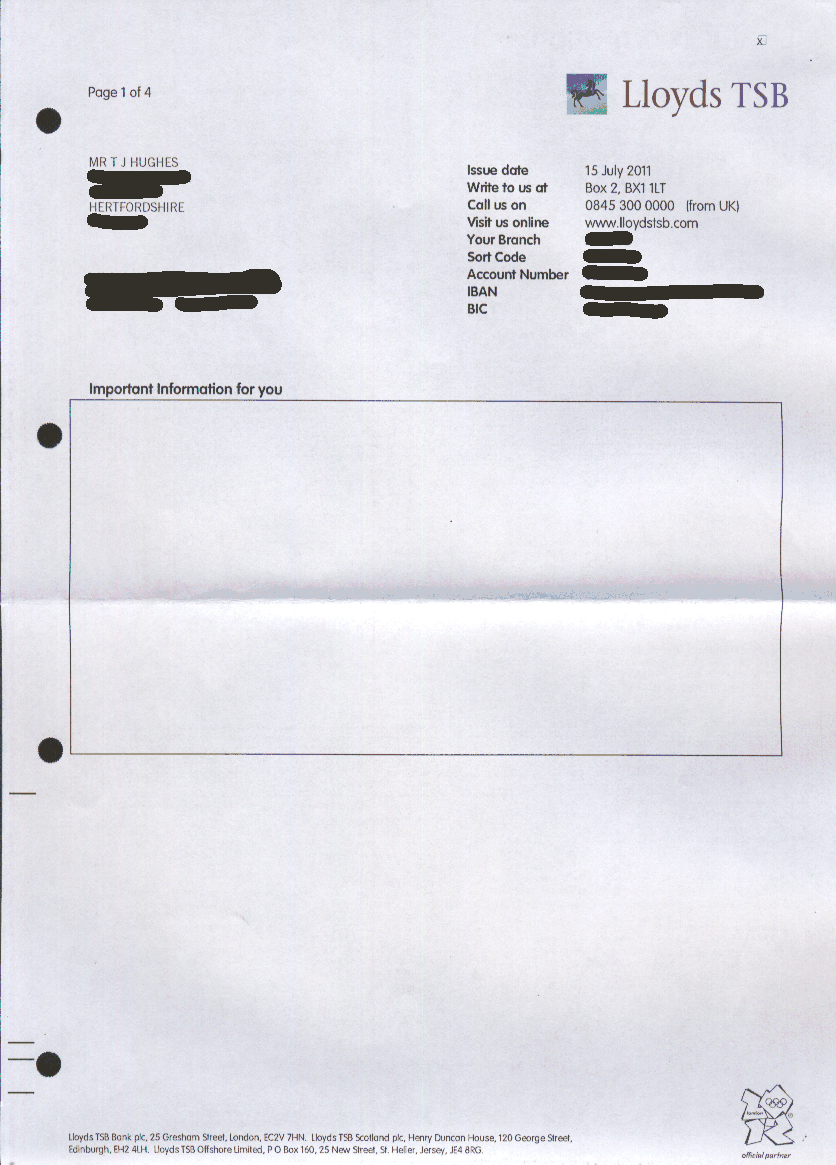
Apparently my bank had some important information to share with me. I know this because they put an extra page in with my statement headed “Important Information for you” which I reproduce here:

Lloyds TSB had some Important Information to share with me...

I wonder how many million of those they’ve just sent out…

Rails Warning Fail

Recent versions of rails 3 have started spitting out a new deprecation warning:

String-based interpolation of association conditions is deprecated. Please use a proc instead. So, for example, has_many :older_friends, :conditions => ‘age > #{age}’ should be changed to has_many :older_friends, :conditions => proc { “age > #{age}” }.

Now call me confused if you like, but isn’t the suggested replacement still doing just as much string interpolation as the original?

City Labels in OpenStreetMap

In the second part of his critique of OpenStreetMap Justin O’Beirne discusses various issues surrounding labelling of cities in OpenStreetMap’s cartography, specifically in our default mapnik rendering of the US.

The issues he highlights can be broadly divided into two categories: problems with our stylesheets and rendering technology; and problems with our data, and in particular with our US data.

The issue which I intend to address here is the one he tackles first – that of label density which is something that stems largely from data quality and, more importantly, consistency issues. Specifically, although the post talks about cities, the real question is about what is tagged as a city and what is tagged as some lesser type of place.

Continue reading ‘City Labels in OpenStreetMap’ »

The Mystery of John Unwin’s Diary

Two weeks ago I travelled to Saltaire with my uncle to hand over a number of items of historical interest from my grandfather’s papers to the Saltaire Archive.

The most significant item in the collection was a personal diary for the year 1897 which carried an inscription on the flyleaf of “John Unwin, Fanny Street, Saltaire”.

Continue reading ‘The Mystery of John Unwin’s Diary’ »

Goodbye Orange, Hello Three

Last month I wrote about mobile phone tariffs and finished by saying that my next step was to call Orange and get a PAC so I could port my number.

When I called Orange they, as expected, put me through to retentions who then rather surprised me by saying that there was no problem adding data to my OVP Virgin tariff and that I could have 500Mb for £5 a month. That wasn’t quite as good as the other tariffs I had been looking at — it was the same price but less data — but I decided to give it a go anyway so he added it to my account.

As my understanding (from searching the internet) was that Orange had two separate classes of SIM only one of which allowed 3G data I explicitly asked if I would need a new SIM but the adviser assured that my current SIM would work fine so off I went to try it out.

Continue reading ‘Goodbye Orange, Hello Three’ »

I think Quidco have a bug

I think Quidco have a bit of a mail merge bug. I just received the following email:

quidco

Somehow I don't think that's what they meant to say...

I wonder how many of those they’ve just sent out…

Playing the Mobile Phone Tariff Game

As a low volume mobile phone user I have, for the last ten years, been on an Orange tariff known as OVP Virgin which price matches the original Virgin Mobile tariff. This is essentially a pay as you go style tariff, with no fixed monthly fees, except that it is paid in arrears by direct debit like a contract tariff. The major advantage of this is that full international roaming is available rather than the restricted roaming available on PAYG tariffs.

The OVP Virgin tariff has long since stopped being available to new customers, but existing customers have been allowed to keep it. Equally Virgin themselves have stopped offering the post pay option on their PAYG tariffs, except for users who have a SIM on their original PAYG tariff. As it happens I have one of those as well…

The net effect of this is that my average bill over ten years has been about £1.25 a month which means that even after buying two phones outright during that period I have come out much better than I would have done by being on contract with a subsidised phone.

I have recently upgraded to a 3G phone however, which meant I needed to find a new tariff as Orange apparently refuse to enable 3G data for OVP Virgin customers, presumably because they would quite like to get rid of them.

Continue reading ‘Playing the Mobile Phone Tariff Game’ »